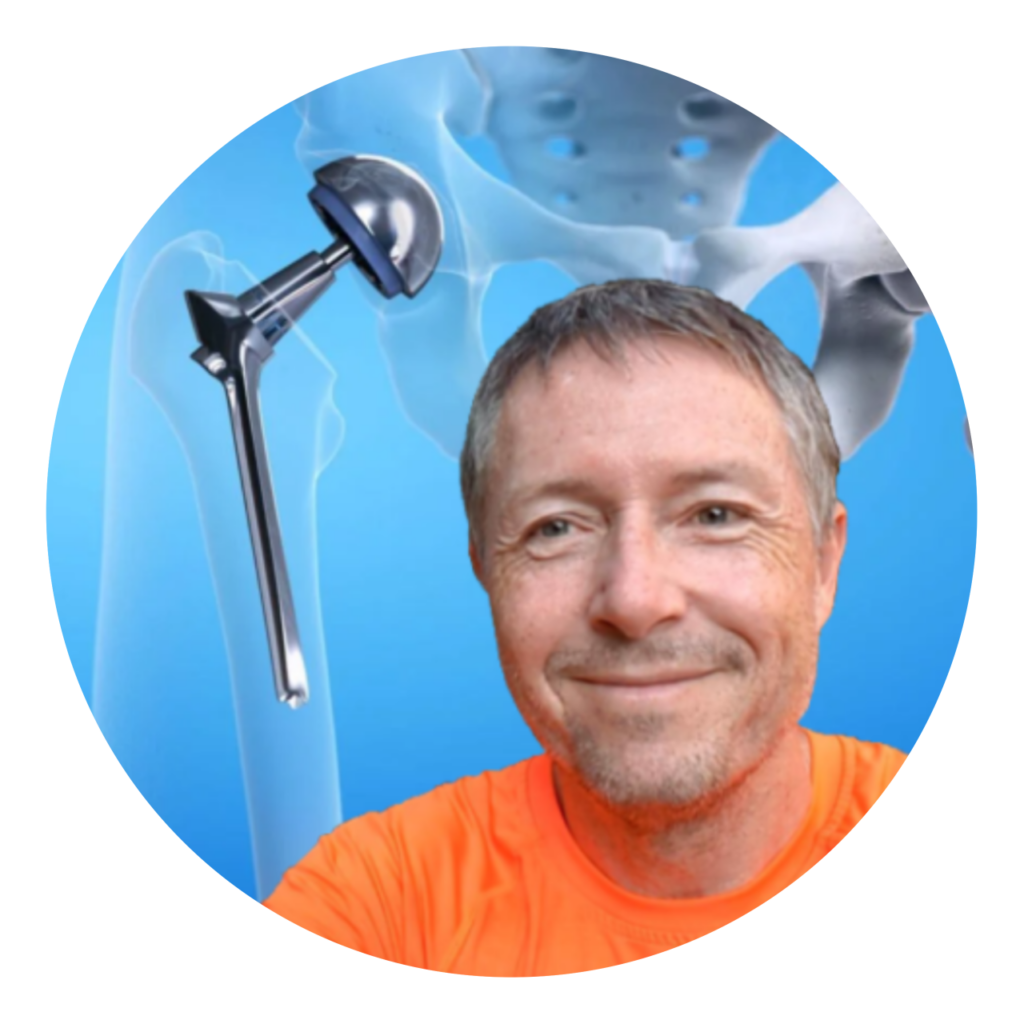

Need to Know Info for Your Total Hip Replacement
👉Click here to watch on YouTube
Key lessons from 18 months after hip replacement, including recovery timelines, walking, physical therapy, realistic expectations, and avoiding setbacks to achieve a successful recovery.
Video Transcript
Welcome to My Hip Vlog
Welcome to my Hip Vlog! I had a total hip replacement 18 months ago, and to celebrate, I’m putting out two very important videos summarizing what I’ve learned through my own experiences and by interacting with thousands of other hippies through social media and my YouTube channel.
In this video, I’ll share the most important things that you need to know, whether you’re facing total hip replacement or already recovering from surgery. Repeat these things to yourself often and keep them in mind throughout your hip journey.
The second video is a quick guide to help you find the videos that are most important and helpful to you, no matter where you are in your hip journey. With over 20 videos in my Hip Vlog, there’s a lot of great content, but I’ll point you to the videos that my viewers have found most helpful and point you in the right direction if you need something specific.
Make sure to watch to the end of this video, where I’ll recommend some important next steps for your hip journey.
About Pete’s Hip Vlog
Did you know that Pete’s Hip Vlog has become one of the most comprehensive resources on the internet for total hip replacement? It’s true. Follow the link in the video description, or go to HipVlog.org, to sign up for some great free resources . The My Hip Journey email system will send you timely reminders and information throughout your hip journey.
Fun fact: Over 2,000 total hip replacements are performed every single day in the U.S. alone. That’s a whole lot of hip replacements.
So, if you find my content helpful, please share it with friends and family. Share it on social media. Share it with your surgeon. Helping people is my passion, so thanks in advance for helping spread the word.
Don’t Wait Too Long for Surgery
Don’t wait as long as possible to get total hip replacement. If you’re still trying to decide whether it’s time to get a total hip replacement, then watch this video, where I go through my decision-making process. You might find it helpful in making your own decision.
While you’re waiting for total hip replacement, it’s not just your hip that’s affected; it’s your whole body. Your body is compensating for the problems with your hip, and that can cause other problems, which may become permanent disabilities. Plus, you’re missing out on life and all the things that you love to do.
If someone is telling you to wait as long as possible, they’re probably operating on outdated information from the time when it was thought that hip replacements lasted only 10 to 15 years. But with modern medical science, hip replacements are now thought to last 20 to 30 years. So don’t wait any longer than necessary.
Everyone’s Hip Journey Is Unique
Everybody’s hip journey is different. My mom is 23 years older than me, but she had her total hip replacement the same year that I did. She was unlucky and had to have a second surgery due to an infection.
Everyone’s hip journey is unique, so our recoveries will be unique as well. We don’t even experience symptoms or pain from a bad hip in the same way.
For example, many of us don’t even feel pain in our bad hips. In my case, my main symptom was groin pain, and that was because my femoral nerve was passing through my inflamed hip joint. That was confusing the femoral nerve, so it sent signals of pain to my groin area. But there was nothing wrong with my groin. There was no actual pain from a problem in my groin; it was just that confused nerve.
It took me six months and X-rays to figure out that this was being caused by a bad hip. I didn’t even know I had a bad hip!
So, while I felt groin pain from my bad hip, other people feel pain in their hips, and some feel it in their lower back. There are many different symptoms we might experience from a bad hip.
Our bodies are complex miracles, so just remember that while there’s a lot we can learn from the medical profession and other hippies going through this process themselves, each of our bodies is unique, and our hip journeys are going to be unique.
Comparing ourselves and our experiences to others is natural, but we have to bear in mind that because our hip journeys are very different, we need to use this information in positive ways to inspire us and motivate us to reach further heights, and not negatively, to feel somehow that we’re lacking or lagging in our recovery.
The Answer to Most Questions
Everybody wants answers, but because our hip journeys are all unique, the answer is often “It depends.”
Remember that when you ask questions like, “When can I do this?” or “Is this feeling that I’m having normal?” the answer is often going to be “It depends.”
So, you may have to dig deeper, weigh multiple different answers, and, in the end, decide for yourself.
For example, what’s the best approach? What’s the healing timeline? Should I do physical therapy or not? And what are the restrictions after surgery, and for how long?
So again, whatever you hear, you need to do some research of your own, challenge assumptions, and then make your own best decisions.
Which Surgical Approach to Total Hip Replacement Is Best?
I’m not a medical professional, but I’ll share my opinion on which approach is best. The answer is: It’s the surgeon, not the approach.
You can have a surgeon who’s mediocre performing the theoretically best possible approach, and your outcome may not be as good as that of a surgeon performing an older or less optimal approach but who is excellent at it.
So, I’ve always felt that finding a surgeon you’re comfortable with is more important than the specific approach.
Whether it’s anterior, posterior, anterior-based muscle-sparing, SuperPath, Mako robotic-assisted, or whatever, there are just an infinite number of these things. But if you have an excellent surgeon who’s using modern muscle-sparing techniques, then your outcome should be very good.
Physical Therapy After Hip Replacement
Another hotly debated topic is whether or not you require formal physical therapy after total hip replacement.
I’ve done some informal research. I’ve actually posted a couple of polls, asked people on the forums, and just kind of monitored things over the past 18 months. As best I can tell, about 50% of surgeons who do total hip replacements recommend formal physical therapy after total hip replacement, and about 50% do not.
So, my surgeon was in the camp that did not recommend any formal physical therapy after total hip replacement.
Now, some of this, I think, is just habit because after every surgery, most surgeons assume that there’s going to be some physical therapy required.
There could also be cases where someone has a pre-existing condition. For example, if they’ve been compensating for a couple of years and have a severe limp or other things that need to be corrected over time through physical therapy, those can be good reasons to have physical therapy.
My 18-Month Post-Op Check-In
Being that this is my 18-month post-op anniversary of total hip replacement, I thought I’d just kind of show you how I look and also let you know how things are going as far as the hip goes.
Everything is going great! I actually played volleyball last night with three other buddies, and then this morning I went for a 16-mile bike ride and then for a couple-mile walk with my wife.
So, in terms of physical shape and my hips specifically, everything’s good. I have some other things going on, but that’s neither here nor there.
I’m trying not to puff out my chest and suck in my gut to look as best as possible. This is kind of how I look. I still probably have five or seven pounds that I wish I could shed, but I haven’t quite been able to do that.

Anyhow, this is kind of me right now. So, if you’re wondering what someone looks like 18 months after total hip replacement, this is one possibility.
But the hip joint is somewhat unique, and it appears, from at least 50% of the surgeons out there, that walking is about all that you need to do in order to heal from total hip replacement. Just don’t do anything to mess it up.
Again, this is something that you’ll have to decide for yourself. In my case, it was actually based on my surgeon’s recommendation and then my own personal experience with physical therapy.
I’ve been through a lot of physical therapy over the years for many different things, and I’ve had mixed results. Sometimes a physical therapist will prescribe things that will actually end up causing additional problems. Other times, they can be very helpful.
So, I don’t have 100% confidence in physical therapists. Just like anything else, there are good ones, there are bad ones, and sometimes mistakes are made.
Based on those two things, I’m comfortable that physical therapy isn’t required for a lot of people after total hip replacement. But you decide for yourself.
Mike’s Check-In
One of the things that I think there is some consensus around is my co-host, Mike the cat!
One of the things that there is a consensus about is how wonderful Mike is as a co-host and just as a companion. I wanted to update you on how Mike’s doing, and I just didn’t think it would be fair to have a video and not have Mike in there.
So, Mike is doing well. We’ve been to the vet a couple of times lately, and he used to weigh 12 pounds. Now he weighs 11 pounds because we can control his food. That happens slowly over time, which is the healthy way to do it for a kitty cat.
The vet says that he’s at a very healthy weight. He could actually stand to lose a little bit more weight, but we think he’s just fine the way he is. I hope you agree!
Anyhow, in all seriousness, the thing that most people seem to agree on is that after total hip replacement, one of the best things for your recovery is walking.
BoneSmart.org
I just want to read you something that I have here on my phone. It’s from a website called BoneSmart.org, which is run by a team of orthopedic surgeons. It’s sort of their overall philosophy on recovering from total hip replacement.
I’ve always found this advice to be very helpful, and I want to read it to you here because they put a lot of thought, I think, into this, and I don’t want to get it wrong.
“Big tip: Hips actually don’t need any exercise to get better. They do a pretty good job of it all on their own if given half a chance. Trouble is, people don’t give them a chance and end up with all sorts of aches and pains and sore spots. All they need is the best therapy, which is walking, and even then, not to excess.”
That’s something I think everybody should bear in mind. It’s really a guiding principle for recovery from total hip replacement, and I hope it leads you to a successful recovery.
And now I must go attend to Mike. He is impatient and wants to get back in the house!
Have Realistic Expectations and Be Patient
Have realistic expectations and be patient. Some surgeons will tell their patients that they have no restrictions, but that can be misleading.
I’ve jotted down a couple of reasons why surgeons might say this. Partly, this is based on a conversation I had with my own surgeon.
Reasons for saying this can include trying to build a practice quickly, a misunderstanding of the research, or acceptance of higher complication rates, etc. So, none of those are good reasons, I think, to say that there are no restrictions after total hip replacement.
Complete healing from total hip replacement can take 9 to 12 months, and integration of the implant into your femur takes a full 9 months.
Don’t worry about how rapidly you’re progressing in the first 6 to 12 months after total hip replacement. Think of the long haul. Think of how this is going to be performing in 20 or 30 years. You want to set the foundation for success.
Progress, no matter how small, is still progress. So, as long as you’re making progress every day, every week, every month, then you’re still making progress, and you’re going in the right direction on your hip journey.
Recovering from modern, minimally invasive, muscle-sparing techniques without overdoing it can be tricky.
Think of it this way: 20 years ago, when they did a total hip replacement, they were making larger incisions. They were cutting more muscles and tendons in order to make this happen. They were using more primitive implants, so there was a lot more damage to your body, independent of the actual implant.
Now, with these modern techniques, they’re doing very minimal damage. They make very small incisions, and they are not cutting muscle, so that part of your body heals a lot faster.
But there’s no way to speed up how fast an implant will integrate with the femur, so that part is just going to take 9 months.
The tricky part is that even though the implant integrating into your femur and the internal healing required can take 9 to 12 months, you feel outwardly pretty good because a lot of that other damage has not been done in a minimally invasive procedure.
So, listen to your body. Be the tortoise, not the hare, and don’t overdo it and suffer setbacks.
Here’s a good rule of thumb: If you feel worse after an activity, then you overdid it. And for the first 9 months post-op, if you feel pain in your thigh, then you overdid it and stressed your implant.
So, heed these warning signs and adjust your activities accordingly.
In terms of having realistic expectations, hope for the best, but plan for the worst.
I think the question of when you can return to work provides a good example of this. While you might be able to return to work in three or four weeks after your surgery, it’s probably not advisable, and you’d be better served by planning for maybe eight weeks after surgery.
Then, if it turns out your recovery progresses sooner than you thought, great! You can go back to work earlier. No problem there.
But if you’ve already planned to return to work after three weeks and then you can’t, that’s going to be a problem for you. That’s going to be a problem for your employer. That’s going to be a problem for your customers. And that might force you to do things that jeopardize your recovery, and you don’t want to do that.
I’m just using returning to work as an example. This could apply to just about anything.
Important Next Steps
Okay, we’ve reached the end of the video, and I promised you some important next steps.
Basically, it boils down to this: Watch these videos. I’ve received lots of feedback from my viewers, and I know which videos they find most helpful. So, I’ve made it easy for you to binge-watch by putting them all here in this one playlist.
I sincerely hope you’ll check it out and share it with others because I think you’ll find it helpful in your hip journey.
So, at 18 months post-op, this is me signing off. I wish you all the best in your hip journey and getting back to the life and activities that you love.
Pete
🚨 Disclaimer 🚨
I am not a healthcare professional, I speak from my personal experience with a hip replacement, from research and what I have learned interacting with thousands of individuals on social media and through my YouTube channel. This video is for informational purposes only and is not a substitute for professional medical advice, diagnosis, treatment, or care. Please seek information from a physician or other qualified healthcare provider before embarking on a new treatment, diet, or fitness program.