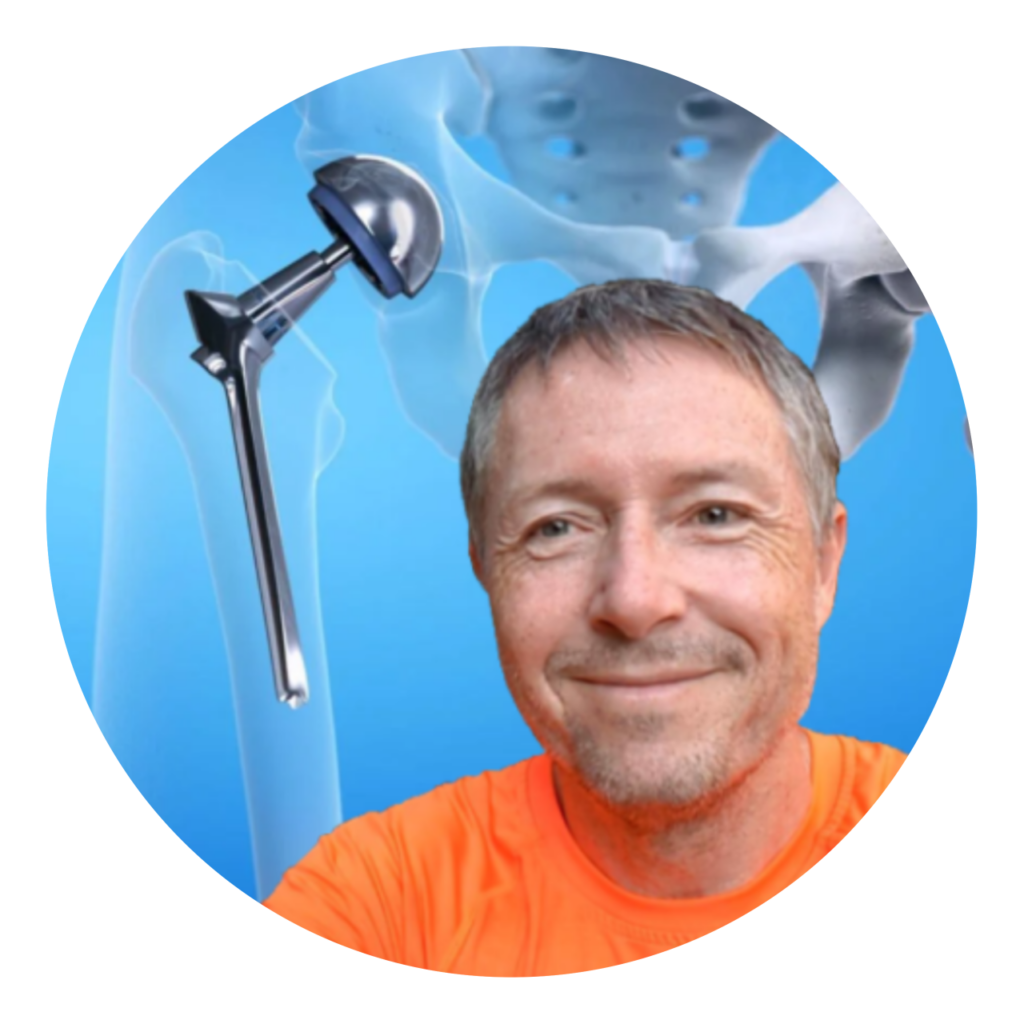

How Long does Healing from Total Hip Replacement Really Take?
👉Click here to watch on YouTube
Wondering how long it takes for a hip replacement to fully heal? Here’s what to know about bone growth, implant stability, and recovery.
Video Transcript
When Will Your Hip Replacement Be Fully Healed?
You’ve just had a hip implanted, or you’re about to, and you’re wondering: When is the bone going to heal enough and be stable enough that I can resume all the activities and the sports that I love?
I’m two years post-op total hip replacement, and I’m taking this opportunity to update some of my videos. This video is one of my most popular and definitely, I think, my most important. So, I hope you’ll stay tuned to the end, where I’ve included some additional research and information to help you understand how to recover successfully from total hip replacement.
There are two camps on this. One camp says your hip replacement will heal just like a bone fracture, or a broken bone, and it should take about two or three months for the bone to completely heal. The other camp cautions that complete integration can take up to nine months, and until that time, you’re at some risk.
When I hear a discrepancy like that, I’m sort of compelled to do some research and try and find some data to support one camp or the other. My goal with this video is not to try and convince you that one camp is correct and the other camp is incorrect. My goal is to provide you with some study information so that you can then decide how to apply this to your unique situation.
About Pete’s Hip Vlog
Did you know that Pete’s Hip Vlog has become one of the most comprehensive resources on the internet for total hip replacement? It’s true. Follow the link in the video description, or go to HipVlog.org, to sign up for some great free resources . The My Hip Journey email system will send you timely reminders and information throughout your hip journey.
Fun fact: Over 2,000 total hip replacements are performed every single day in the U.S. alone. That’s a whole lot of hip replacements.
So, if you find my content helpful, please share it with friends and family. Share it on social media. Share it with your surgeon. Helping people is my passion, so thanks in advance for helping spread the word.
Disclaimer and Approach to the Research
We all enjoyed playing doctor as kids, but I’m not a medical professional of any kind. In my professional career implementing systems, however, I got to be known as the data guy. And that’s because I didn’t listen to anecdotes. I didn’t listen to what people were telling me, especially if things sounded ambiguous. I always tried to find actual data to support claims and to make decisions based on that data.
And you know what was interesting? Almost all the time, the things that we were hearing anecdotally were incorrect, and it turned out that the truth was something very different.
So, I hope this video will help you make the correct decisions in your hip journey.
First, some terminology.
What Is Osseointegration?
Osseointegration, also sometimes referred to as bone ingrowth, refers to the firm anchoring of a surgical implant by the growth of bone around it without fibrous tissue formation at the interface.
That last bit, “without fibrous tissue formation at the interface,” is very important, and I’ll discuss that more later.
As I was researching this topic, a few things struck me. Number one, there’s a lot more information out there about osseointegration of dental implants than about joint replacements. Second, there are very few human studies of osseointegration for joint replacements. And third, there’s a widely held theory that osseointegration of joint replacements follows closely the bone-healing process that surrounds fractures and bone breaks, for which there’s a ton of research data.
Study 1: Human Bone Ingrowth Into Porous-Coated Implants
This was the best study that I could find on this topic, and it’s entitled Progression of Human Bone Ingrowth into Porous-Coated Implants: Rate of Bone Ingrowth in Humans.
And if you want to look at the full article, you can find the references here and look it up for yourself. I will try to include these in the video description as well so that you can easily check out the full article yourselves.
Before I go over the details of these studies, I wanted to save you some time by summarizing some things up front.
After total hip replacement, I wanted to get back to the activities that I love, but without jeopardizing the useful life of my prosthetic. After all, I’m in this for the long haul.
My surgeon, Dr. K, told me that it can take up to nine months for complete osseointegration and to be cautious until then. When I heard others saying that this should be completely healed in two to three months, just like a bone fracture, I really wanted to believe it so I could get back to all those activities that I love.
But Dr. K has performed over 8,000 total hip arthroplasties, including 4,000 using the new minimally invasive and muscle-sparing techniques. In fact, he retired about five months after he performed my hip replacement, sort of at the apex of his career, knowledge, and experience, and he’s sharing that with others by training the next generation of surgeons.
So, I have a lot of confidence that Dr. K knows what he’s talking about.
Study 1: Summary of Findings
So now I’m going to go over the study summary, which has to do with the pace at which bone integrates into the prosthetic.
Okay, and I’ve provided you a little table here. It’s got time, bone in prosthetic, and then the percentage of total.

So, for example, if you look at the three-month line, that is 10% bone found in the prosthetic at three months post-op, and that 10% represents 38% of the total. The final total (at nine months) is 26% bone in the prosthetic.
Obviously, it can’t be 100% because it’s mostly made of titanium. But with that porous surface, though, they found that there was a total of 26% bone integrated into the porous surface of the titanium implant.
That third column kind of tells you what your progress is, right? So, if I’ve got 10% bone in there, but I’m going to ultimately have 26%, then 10% represents 38% of that total.
Another way of looking at that is that at three months, I’m 38% of the way to complete osseointegration of my implant.
So, as you can see, looking at the numbers, at three months post-op, you’re only 38% of the way to complete osseointegration. At six months, you’re only 58% of the way, so that’s just a little bit past halfway.
Now, at nine months, you’re at 100%. So, if you can manage things appropriately and not mess up your prosthetic, then you will have complete, solid integration at nine months post-op, give or take.
Now, of course, this can vary a lot depending on individual circumstances, bone quality, age, other comorbidities, things like that.
What Does Load Bearing Mean for Bone Healing?
The other thing that I found is that normal load is important, as it stimulates bone healing. Normal load has to do with walking, activities, and things like that—not doing extreme activities or carrying heavy weights around.
And then, finally, one of the things Dr. K cautioned me about were activities that might damage that initial bone growth. And I found support for that in some of these studies.
They talk about a fibrous encapsulation, and if you have too much micro motion of the prosthetic inside the bone, that will prevent proper bone integration. Instead, this fibrous capsule forms around the implant, and that can ultimately lead to aseptic loosening and failure.
Study 1: Detailed Findings and Discussion
If you’ve been told something different, or you’re skeptical of what I’ve shared so far, I don’t blame you. I would encourage you to just listen a little bit further as I go through the details of the study so that you can make your own best decisions.
To start off, I’m just going to read some sections here.
Starting:
“We report the measured progression of human cancellous bone ingrowth into load-bearing porous-coated titanium implants over five time periods: 0, 3, 6, 9, and 12 months.
There was a statistically significant progression of bone ingrowth into the implants over a nine-month period, but the nine- and twelve-month data were not different.
Investigators are advised to analyze Time Zero implants in order to distinguish mechanical impaction of bone from the biological process of bone ingrowth.
Early investigations of bone ingrowth using canine and baboon models, non-quantitative human implant retrievals, and other studies suggest that bone ingrowth is a fracture-healing event occurring within four to twelve weeks postoperatively.
More recent studies have suggested that the bone ingrowth process in human cancellous bone proceeds much slower.
Thirty-six patients, each with bilateral knee arthrosis, consented to participate in this study. The ages of the patients averaged 67 years. Staged bilateral total knee arthroplasties are the prescribed treatment for patients in our community when both knees have severe arthrosis.
During the first TKA surgery, and only after uncomplicated completion of the initial arthroplasty, the cylindrical implant was inserted.
Results: Porosity and bone ingrowth analysis.
The volume fraction of bone measured within the porous coating in the Time Zero patients was 1%. This represents the amount of bone impacted into the porous coating at the time of insertion.
The three-month patients had an average of 10% bone in the porous coating. This represented an early progression of bone ingrowth that was significantly different from the Time Zero implants.
Bone ingrowth continued to progress into the porous coating at the six- and nine-month time periods. The six-month implants had an average of 15% bone in the porous coating, while the nine-month group showed continued bone ingrowth, averaging 26% in the porous coating.
The bone ingrowth in the twelve-month group measured 24%. This did not differ from the nine-month group.
When the data were organized graphically, it became evident that there was a continuous progression of bone ingrowth from the Time Zero implantation, with the plateauing of the bone ingrowth occurring around nine months.
Discussion:
Our findings demonstrate that human bone ingrowth plateaus around the nine-month postoperative period. These results in human cancellous bone conflict with previous qualitative investigations, which reported bone ingrowth within four to twelve weeks.
One of the reasons for the differences between our findings and others was that animal models were used. Charnley, Bloebaum, et al. and Bobyn et al. and others have shown that bone remodeling and healing in animals may not be representative of bone healing in humans.
This may explain why Carlson and Linder observed bone appositional healing in human cancellous bone, whereas advocates of the fracture-healing model describe their findings as similar to cortical bone-healing properties after fracture.
There are other factors which may have contributed to the confusion in the literature. Many investigators did not conduct Time Zero implantation, which would be essential in interpreting the time frame for bone ingrowth.
Spector et al. mentioned that they had deliberately under-broached the bone to allow for bone impaction. This has been a common practice in many bone-ingrowth investigations.
The absence of Time Zero implantations in these types of investigations would make it impossible to isolate the biological event of bone ingrowth from the combination of bone impaction and bone ingrowth.
Another factor that must be considered is the type of porous coating. For example, if the coating protrudes beyond the substrate and if the bone preparation is undersized, then again, Time Zero implants would be required to distinguish between initial bone impaction and/or bone ingrowth.
The porous coating used in our investigation is flush with the substrate and does not protrude. This would explain the limited impaction seen in the Time Zero implants.
We also found new bone formation in the periprosthetic bone at the interface, as well as corresponding advancement of the bone into the porous coating over the nine-month period.
These observations do not support the fracture-healing model that is commonly reported, but not histologically, quantitatively measured using histometric and fluorochrome-labeling techniques.
A careful review of the literature now suggests that to achieve reproducible skeletal attachment by human bone ingrowth into porous coatings, the coating should be within this distance of the human cancellous bone. The implant should be inherently stable and should limit activity within the first nine months after surgery.
In conclusion, our findings show that maximal bone ingrowth is achieved around nine months post-implantation, and that the progression of human cancellous bone ingrowth into the porous coating is slower than previously reported.
These quantitative results conflict with previous animal and clinical studies that did not perform Time Zero implants to determine the combination of the effects of bone impaction and bone ingrowth on the amount of bone observed in the porous-coated implants.”
Cancellous Bone vs. Cortical Bone
If you’re struggling a little bit with what that last study said, which is that it can take up to nine months for the stem of your prosthetic to integrate into your femur, then this might help.
In that last study, they talked about the differences between two different types of bone. There’s cortical bone and cancellous bone, and here’s some explanation.
Bones are divided into two macroscopic forms: cancellous bones, AKA spongy, and cortical bones, or compact bone.
Cortical bones make up most of the skeleton, while the rest is cancellous bone, roughly 20%.
Study 2: Osseointegration Fundamentals
I found this other study, which is helpful in understanding this osseointegration: A Review of the Fundamentals for Assuring Cementless Skeletal Fixation.
In the case of osseointegration within long bones, cortical bone porosity ranges between 5% and 10% in skeletally mature individuals, while the porosity of cancellous bone varies between 50% to 95%.
The increased pore space of cancellous bone results in an approximate three- to eight-fold reduced bone density compared with cortical bone and explains the 30-fold reduction in strength and stiffness between the two bone types.
So, they mentioned down here that this also contributes to the known metabolic differences between cortical and cancellous bone remodeling, and further they say that the way cancellous bone heals is significantly different from the healing pattern and cascades of fractured cortical bone.
So, in other words, when you insert the stem into the center of a cancellous bone like your femur, the healing process is going to be very different than if you broke a bone.
You can read the entire conclusion section of this paper if you wish, but I’ll just highlight something at the end.
It says:
“While initial implant fixation is required to prevent micro motion and fibrous encapsulation, the long-term success of osseointegration implants requires firm skeletal attachment, which may take up to three to nine months post-operatively in human cancellous bone.
Immediate full load bearing in the post-operative period has several benefits, including a shorter hospital stay, lower hospitalization cost, and an earlier return to daily living.”
Of course, when they’re talking about load bearing here, they’re contrasting that with the old practice, which was to prevent load bearing. So, if you broke a bone, you would not walk on it. You would stay off of it for potentially several months.
Now they’ve found that actually having some load on the bones promotes healing. So they’re saying, you know, full load bearing has its benefits, but they’re not suggesting extreme activities or lugging heavy weights around.
What Is Micromotion?
One of the things you might be struggling with after hearing all that research is: What exactly qualifies as micro motion, and how do I restrict micro motion and avoid doing micromotions that might harm the healing process of my implant?
And it’s not easy, so I’ve tried to provide here some additional information to allow you to better manage your own recovery.
So, here’s a study I found. It’s called The Limit of Tolerable Micromotion for Implant Osseointegration: A Systematic Review, and they start by saying:
“Much research effort is being invested into the development of porous bio materials that enhance implant osseointegration. Large micromotions at the bone-implant interface impair this osseointegration process, resulting in fibrous capsule formation and implant loosening.”
I also found this definition of micro motion:
“Micromotion is the movement between the bone and an implant surface when the implant is loaded.”
Micromotion can be caused by a number of factors, including the implant material, bone density, and surgical technique.
And then I asked the question, “Okay, so what activities cause micro motion in total hip implants?”
And the AI-generated answer is as follows:
“Micromotion in hip implants is influenced by various activities, with gait and stair climbing being notable examples. Gait loading conditions cause minimal micro motion in well-fixed, uncemented total hip replacements. However, when the loading is increased to simulate stair climbing, the micro motion significantly increases.”
And when I see that, I always think about what my surgeon told me about climbing stairs. He said it was an activity that put undue strain on your implant, and that it was a rotational force. So, he said, as you’re going stair over stair, that is actually exerting a rotational force on the implant, which can cause some micro motion and some loosening.
So, I tried to do just the single step, you know, “up with the good, down with the bad,” for several months after my total hip replacement to minimize that risk.
But you really have to decide which activities you’re going to allow yourself to do or restrict yourself from doing so that you can achieve the risk-reward balance that you’re most comfortable with.
So, anyhow, continuing on with this, you know, micro motion is a function not just of primary implant stability, but also of the differences in the elastic modulus of bone and in the implant material.
I thought that was really interesting because I always thought bone was rigid, right? But it turns out that bone is always changing and that bone is flexible.
And so, you take a rigid implant, right? So, your stem, which is made of titanium, and you put that into a bone which is a little bit flexible. And when you flex that bone, that means that that rigid implant is going to be pressing on different parts of the bone. It’s going to have motion, right?
And that motion can cause this loosening and the formation of that fibrous capsule.
So, continuing on, they also say that the increase is more pronounced in implants with less contact between the implant and bone.
And if I then flip back to another study, they noted that even for the most talented surgeons, it remains impossible to produce an absolutely conforming host site that shows no gaps over the entire surface area.
So, what does that mean to you and me?
What that means to me is that when I’m selecting my surgeon, I want to be very careful. I want to choose a surgeon who has a very good reputation, I feel comfortable with, and has a low overall complication rate, because things like loosening of an implant would be considered a complication.
So, those are going to be primary things. And then you just have to realize that not all surgeries are going to be identical. Not all surgeons are identical. So, it is worthwhile to take some precautions as you heal from total hip replacement.
Okay, continuing on with the study, it says:
“Additionally, activities that generate higher frictional moments, such as certain daily activities, including stair climbing, sit-to-stand transitions, and knee bending, can also contribute to micro motion.”
And really, you know, at this point I’m just thinking, “Okay, how do I apply this to my daily life?”
And I guess what I always thought of is, you know, what is micro motion?
It is jostling movements. It is jarring movements. It is vibration-type movements.
So, what are the activities that would involve micro motion that I perhaps want to avoid while my implant is still healing and osseointegrating with my femur?
So, I think of things like horseback riding, right? That’s a very jostling motion.
I think of bike riding outside, especially if you’re doing mountain biking. That’s a very jarring, jostling activity.
Sports like running or jumping activities, or even ones where you do quick directional changes, so like tennis or pickleball or volleyball. All those things, in my opinion, could result in micro motion.
So, in my case, I tried to weigh the risk and reward of those activities.
For example, I started back with volleyball before my implant was fully osseointegrated, but I took it very slowly. I really avoided any of the extreme activities, jumping, diving, and things like that that could cause a problem.
And when it came to biking, I waited until about eight months because, at that point, I was almost fully osseointegrated and I felt it was safe.
So, you know, you have to make your own choices in your own hip recovery, but hopefully this information will help you make a better-informed choice so that you can hopefully have 20 or 30 good, useful years out of your new artificial hip.
And with that, and with your new artificial hip, you are officially a cyborg. So, welcome to the crew.
Pete
🚨 Disclaimer 🚨
I am not a healthcare professional, I speak from my personal experience with a hip replacement, from research and what I have learned interacting with thousands of individuals on social media and through my YouTube channel. This video is for informational purposes only and is not a substitute for professional medical advice, diagnosis, treatment, or care. Please seek information from a physician or other qualified healthcare provider before embarking on a new treatment, diet, or fitness program.