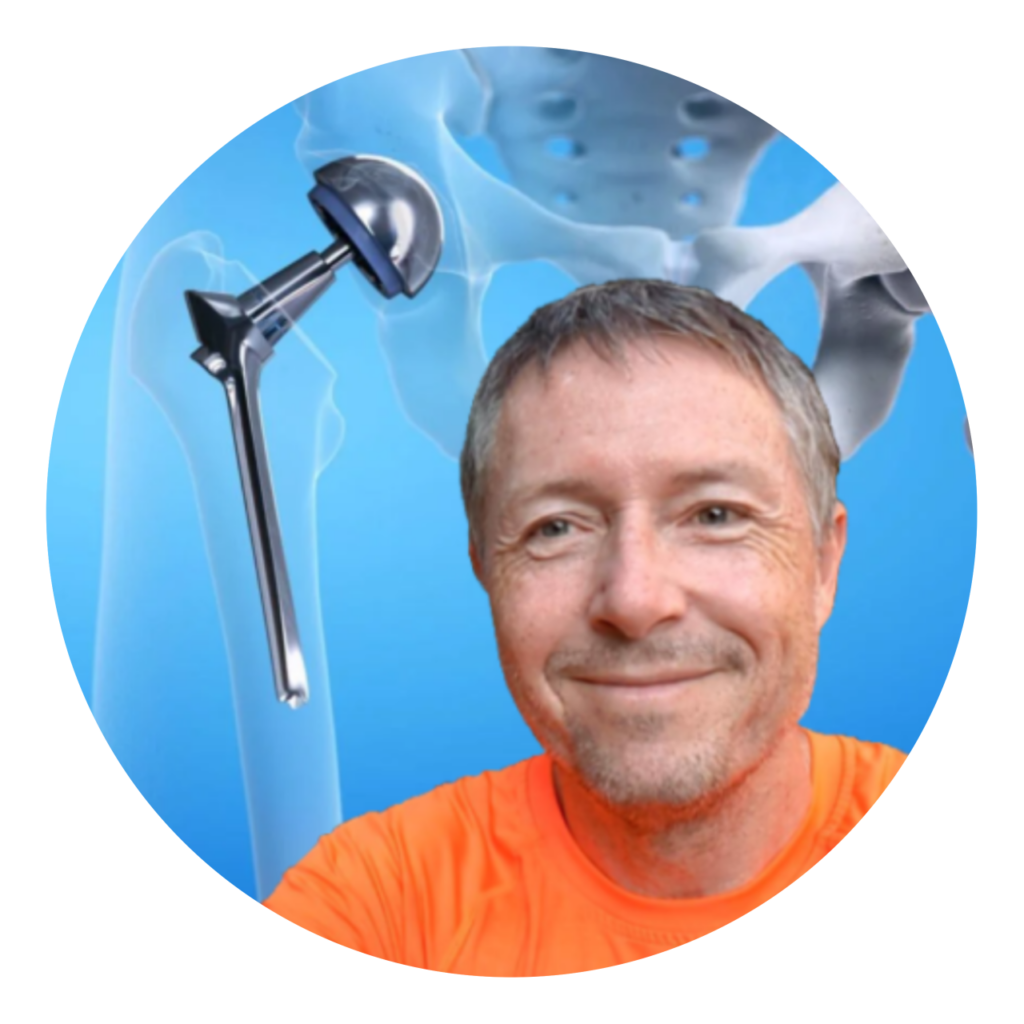

👉Click here to watch on YouTube
Pete reacts to Steve Carell’s hip replacement story, exploring surgery pain, timing, implant materials, anesthesia, and why every hip replacement experience is different.
Video Transcript
Steve Carell’s Total Hip Replacement: Reaction Video Transcript
Some of you may be familiar with the actor Steve Carell from The Office and other movies. I’ve never been a fan of The Office, but I do like him in other movies. At any rate, he had a total hip replacement a couple of years ago, and my producer asked me to do this reaction video to his comments on total hip replacement. So, here we go!
Is Hip Replacement Really That Bad?
Interviewer: “I hope this isn’t too personal, but you had a hip replaced?”
Steve Carell: “I did.”
Interviewer: “That was a bad day. That must be a pretty bad day.”
Steve Carell: “Yeah, that was.”
So, is hip replacement a bad day? It really depends. Every individual is going to have a different experience.
For me, it was a very rough day and a very rough first week post-op. But what I’ve heard is that people who have bone-on-bone arthritis often feel immediate relief, like right after the surgery.
It’s going to depend. I’ve also heard of people who don’t need a lot of painkillers and things right after the surgery. All these things are going to vary a lot.
For me, right after surgery, I really did not request painkillers fast enough. When the anesthesia wore off, I was in excruciating pain, almost unable to think or talk.
That’s one experience. Again, I hear from people who were just like, “Oh, I took a couple of Tylenol, and that’s all I ever had to take, and I feel great.”
It’s going to vary a lot, but some of you could have a very bad day.
Now, let’s see what else Steve experienced.
When Should I Replace My Hip? (NEW DATA)
Steve Carell: “A year ago, I had a hip replacement, a full hip replacement. And I held off as long as I could until the doctor said, ‘Hold off until you start to limp, and then have a hip replacement.’ So, I went in.”
That’s an interesting point, and what you’ll find is that different doctors recommend different things.
Nowadays, total hip replacements using modern techniques and modern materials should last 20 or 30 years. So, unless you’re very young, the chances are that your hip replacement is going to last you for the rest of your life.
Even if you need to have a revision done at some point, my surgeon told me that it’s possible to have two total hip replacements done in your lifetime because there’s enough bone in your femur. So, that’s like 50 or 60 years of use of an artificial hip. I can’t imagine anyone running out of time for that!
Now, it used to be believed, with older surgical techniques and older materials, that total hip replacements didn’t last that long. They might last 10 or 15 years. In those days, they certainly did say, “Wait as long as you can,” because you didn’t want to have one at 60, then another at 70, and then another at 80, and be miserable.
I feel like that information was a little outdated, but it’s hard to know. Maybe Steve didn’t have a surgeon who was employing all the latest techniques and technologies.
Let’s listen a little further.
Shaved for Surgery!?
Steve Carell: “My wife brought me in, and Yolanda shaved my pubic hair. I’ll just say it. Which I didn’t know—I didn’t know Yolanda was going to be doing that.”
Okay, so let’s talk about that.
I did watch another reaction video reacting to this, and they said, “Well, if they shaved his pubic area, then it must have been an anterior approach.”

I’ve looked at many, many incisions from all different approaches to total hip replacement, and I’ve never seen them get near the pubic area. I don’t know what size bush Steve Carell has, but I just can’t imagine them having to trim that.
That said, I don’t know what was going on there, and I believe him. They must have had a unique approach to this or some other factor.
I did not experience that. If you look at most of the incisions, they’re on the side of your hip, and I don’t think most people’s pubic area extends quite that far.
Anyhow, in my case, they didn’t have to shave a whole lot, and I haven’t seen or heard of that happening very often. So, I guess Steve is a unique individual!
About Pete’s Hip Vlog
Did you know that Pete’s Hip Vlog has become one of the most comprehensive resources on the internet for total hip replacement? It’s true. Follow the link in the video description, or go to HipVlog.org, to sign up for some great free resources . The My Hip Journey email system will send you timely reminders and information throughout your hip journey.
Fun fact: Over 2,000 total hip replacements are performed every single day in the U.S. alone. That’s a whole lot of hip replacements.
So, if you find my content helpful, please share it with friends and family. Share it on social media. Share it with your surgeon. Helping people is my passion, so thanks in advance for helping spread the word.
What Will Your New Hip Be Made Of?
Steve Carell: “He just decided again, like the baboon. No one tells me anything. So, the pubic hair is shaved, and then the doctor came in and said, ‘So, let’s talk about your hip. What do you want it made out of?’
“And I thought, ‘This has been months leading up to this, and I’m about 20 minutes from having this permanent piece of body installed.’
“Well, you could go with titanium, or you could go with… I’d recommend the ceramic because it’s very, very durable. It might last forever. However, it might squeak.”
That’s the one!
When it comes to materials, my understanding is that the gold standard right now is a titanium stem, a ceramic ball, and a polyethylene cup. That’s going to give you good wear characteristics.
Those polyethylene cups have been perfected over many, many years. The materials show almost no wear after 20 years. That’s what I’ve heard from some surgeons.
The ceramic ball is very, very strong and very smooth, so it provides smooth operation. You generally get the squeaking if you have a ceramic ball and a ceramic cup. That’s ceramic-on-ceramic. You can imagine what that sounds like!

But with just ceramic on polyethylene, that should be fine.
There are other options around the world. Some people use metal balls and metal cups, among other combinations. Some countries may not employ the latest technologies, and they may be trying to save money by using slightly older technology.
At any rate, what I had was a titanium stem, a ceramic ball, and a polyethylene cup that the ball goes into, right? My surgeon told me that was the gold standard in total hip replacements.
He did give me choices. He said I could go for ceramic-on-ceramic if I wanted, and he warned me about the squeaking.
As someone who, for about 40 years of my life, had squeaky ankles and people could hear me coming down the hall, I didn’t really want to get a squeaky hip and have the same experience.
At any rate, let’s see what else happened to Steve.
Steve Carell: “Like, okay, do I want it to last? But do I want this…?”
By the way, I don’t know what the deal was. If Steve’s being honest and not just exaggerating for humorous effect, then I don’t know what to say about his surgeon.
But surgeons like mine had conversations with me very early on about the materials that would be used for my prosthetic. I think my surgical process went very much the way he had told me it would.
He provided me with copious amounts of information. He had me watch videos that he had prepared for all his patients to help me understand the process.
He even created an automated text messaging system that would send me text messages at different stages as I was nearing surgery and then post-op. You could also ask it questions. You could send a keyword, and it would provide you with information about that.
It was very cool and very transparent. He provided a lot of great information, and I never really felt in the dark.
Although I will admit that when you go through something like this, you always have lots of questions, and you’re never going to have them all answered satisfactorily.
So, you just hope that your surgeon has good bedside manners and is a good communicator.
The Squeaky Hip
Steve Carell: “Squeaky hip! So, I went with the ceramic squeak hip, yeah. And I said, ‘Give me the squeaky one!’
They did me up, and the guy doing the anesthesia said, ‘Now, do you want to see any of the operating room? Do you want to have any awareness from here on out?’
I said, ‘Not at all. I want to be asleep for the next several weeks. I don’t want any recollection of this.’
So, he gave me my medication, but it didn’t quite kick in as quickly as it should have. They rolled me into the operating room, and it looked like a torture chamber.
There was a bed. The operating table looked like a spit or a rotisserie that you would roast a chicken on. What they do is put you on this table, strap you down, and turn you around so they can get better access wherever they need to go to chop out the hip.”
What he’s actually describing is a bed that was developed for performing total hip replacements. Before the development of that table, it was a much more difficult procedure. Surgeons weren’t able to perform it using the same muscle-sparing and modern techniques.
That really revolutionized things.
Now, there’s no getting away from the fact that total hip replacement is a brutal surgery, right? I have not watched an actual operation yet because I don’t think I could handle it.
The closest I’ve come is a video where a surgeon mom walks her small son through the procedure using a Play-Doh hip.
I’d highly recommend that video. It’s very entertaining, and it’s actually very accurate. It goes through all the steps, but it uses Play-Doh, so there’s no blood, flesh, or gore.
In a total hip replacement, however, it is brutal, right? They take your femur, cut off the head, and then use a big, conically shaped reamer to ream out the center of your femur bone.
Then they take the stem of the implant, stick it in there, and use a hammer to bash it into place.
It’s such a forceful process that sometimes, if they haven’t braced you properly, it can cause damage to your knees and other joints as they’re hammering that thing in.
So, it is not a benign process. It’s a pretty brutal procedure. We sometimes think of medicine as being all clean and sterile, but there’s a lot of blood and gore involved in this surgery.
But, speaking of anesthesia, the norm is a spinal block, which is an initial injection, followed by something called propofol, which is also nicknamed the “milk of amnesia.”
That allows you to be aware but not remember anything that happened.
Thank goodness! I actually looked at the surgical notes after my surgery and saw that my surgeon had been having conversations with me in the surgical theater. I don’t remember any of that, thank God!
Evidently, this anesthesia, propofol, allows you to be somewhat aware but not remember anything. That is a blessing.
Steve’s Experience in the Operating Room
Steve Carell: “I was freaking out, and I saw axe saws, and the last image I had in my head was a woman putting on a helmet.
And I’m not even kidding. It was a helmet with a huge visor and a light, and I just saw these eyes. Then I went out in abject terror.”
So, there you have it!
I know every surgeon is a little different, and everybody’s experience is a little different.
What did your surgeon tell you that was different from what Steve Carell experienced? Or what did you experience that was different from Steve?
Please let me know in the comments. Have a great day!
And remember, you’re in charge of your own health!
Pete
⚕️ Medical Disclaimer
I am not a healthcare professional. Content on Pete’s Hip Vlog is based on my personal hip replacement experience, research, and conversations with our recovery community. It is for general informational and educational purposes only and is not medical advice, diagnosis, or treatment.
Everyone’s recovery is different. Consult your healthcare professional about your individual circumstances, and never delay or disregard medical advice based on content you watch or read here. For concerning symptoms or a possible medical emergency, seek appropriate medical care promptly.